Books are healing. They always have been.
There is a moment — most of us remember it, even if we can't name the exact book — when reading stopped being a skill and became a sanctuary.
You were young. The world was wide and sometimes overwhelming. And then a story opened up a door that wasn't there before, and you slipped through it, and for a little while everything was different. Lighter. More possible. You came back to yourself rested in a way that sleep, somehow, didn't always manage.
That is what Hilom Harana believes books do. Not metaphorically — actually. Reading heals.
The Keepers of stories is a collection of hand-painted children's canvas book bags, 3 bags for each series is a donation to an independant bookstore to gift to a child who might need exactly that sanctuary. And each one is painted in the hope that the bag itself — before the books even arrive — might already feel like a gift worth keeping.
Where This Began
The name Hilom Harana translates, from Filipino, as heal in life's serenade. It is the philosophy at the root of everything made under this name — that beauty is not decoration, but medicine. That art, carefully made and given with intention, can reach places that words alone cannot.
The Keepers of stories was born from that same belief, turned toward childhood.
Children's literacy charities across the UK know what the research already confirms: access to books in early childhood is one of the most powerful predictors of wellbeing, empathy, and emotional resilience across a lifetime. But access alone is not enough. A child also needs to feel that stories belong to them. That books are not obstacles or obligations, but companions — alive, generous, and on their side.
That is the feeling each of these bags is trying to give, before a single page is turned.
The Collection: Three Keepers of Stories
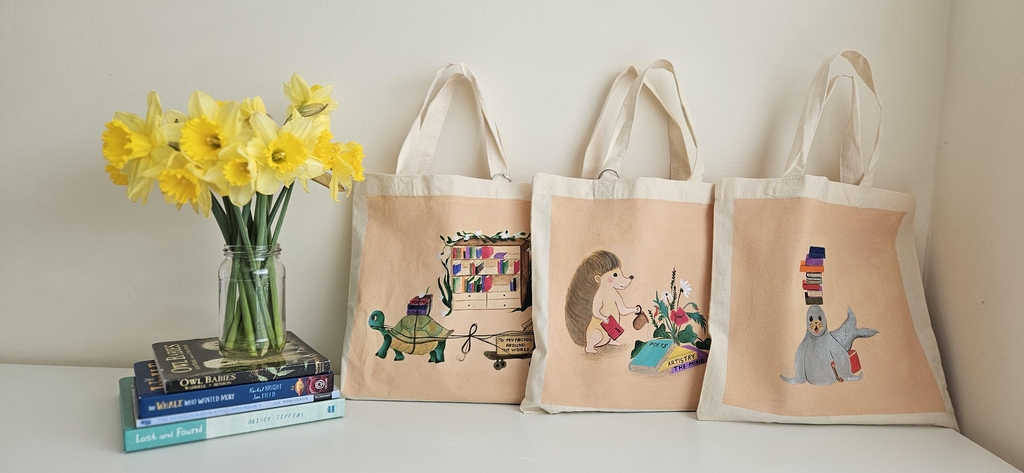
The first story features three hand-painted characters, each rooted in a specific folklore tradition, each chosen because their story — in its original telling — is already about the power of narrative to heal, transform, or carry something precious across impossible distances.
🦔 The Hedgehog Librarian renamed Hedgehog Gardener
English Folklore
In the tradition of the English countryside, the hedgehog is a creature of patient wisdom. She moves slowly, notices everything, and carries her home on her back — which means she is never, truly, without shelter.
In this painting, the Hedgehog Librarian tends her books the way a gardener tends a meadow. She waters them with a small copper can. From between the pages of her stack — Poets. Artistry. The Mind. — poppies and daisies and dark-leafed ferns push upward, reaching for light. The books are alive. The stories are growing.
The watering can is the heart of this image. It asks: what would happen if we treated children's reading the way we treat a garden? If we gave it time, and warmth, and daily attention, and trusted that something was growing even when we couldn't yet see it?
The meadow botanical border — poppies, white daisies, the soft blue of cornflowers — grounds the image in the English countryside the hedgehog calls home, and connects it to the broader visual world of Hilom Harana, where flowers are never just decoration.
🦭 The Selkie - Reimagined "The Seal of enthusiasm"
Scottish & Irish Coastal Folklore
The Selkie is one of the most quietly heartbreaking figures in Celtic mythology. She is a seal who becomes human when she removes her skin — a being who lives between two worlds, who belongs fully to neither, who carries within her an ache for the ocean even when she is walking on land.
For children who grow up between cultures, between languages, between the world their parents came from and the world they are growing into — the Selkie is a mirror.
But in The Keepers of stories, the Selkie is not lost. She sits at the threshold of the sea, a book open in her lap, her seal skin folded beside her like a coat she chose to take off. The ocean is still there — she can go back whenever she needs to. But right now, she is reading. And the story she holds is a world she can live in fully, without negotiating which part of herself to leave at the door.
Around her: sea kelp, sea pinks, the small shell-strewn botanicals of a Scottish shoreline. The bag's background carries the blue-grey of coastal water before the sun rises.
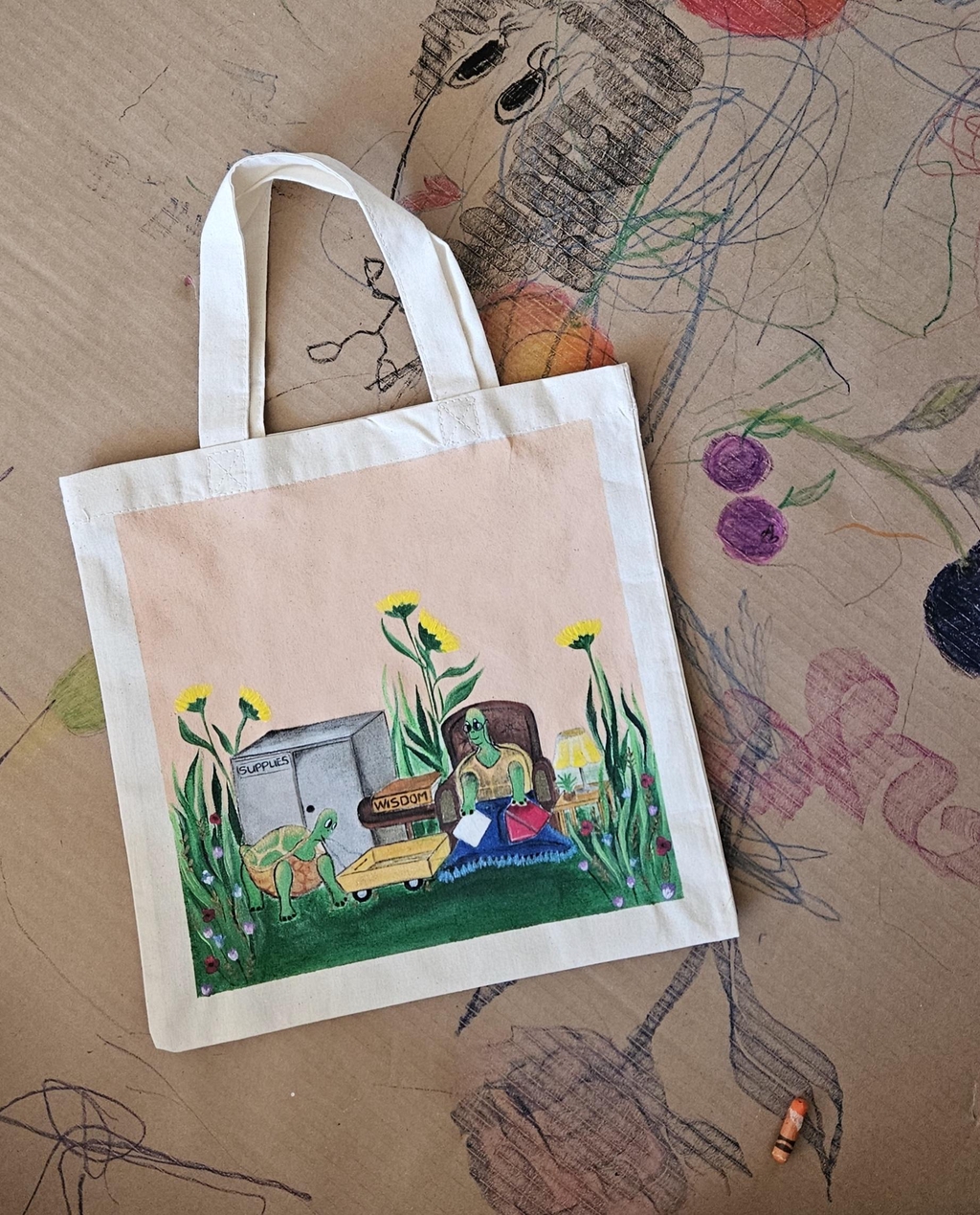
🐢 The Tortoise Who Outread Everyone - reimagined "Thoughtful Tortoise"
West African Yoruba Tradition
In Yoruba folklore, the tortoise — Ijapa — is the great trickster. Clever, unhurried, and almost always underestimated. He moves slowly and arrives everywhere. He is patient in ways that frustrate faster creatures, and that patience, in the end, is always what wins. In this story, Ijapa has found his greatest pleasure: he has discovered books. And he has outread everyone.
This painting is for every child who has ever been told they were too slow, too quiet, too different. The tortoise wins not despite his nature — but because of it.
Why These Three?
The Hedgehog is English. The Selkie is Scottish and Irish. The Tortoise is West African.
They were chosen not to cover ground geographically, but because each of their folklore traditions already contains, at its heart, a story about what it means to carry something precious across a distance — and to arrive, eventually, somewhere safe.
The hedgehog carries her home. The Selkie carries two worlds. The Tortoise carries time.
Books do all three of these things. A book is portable shelter. A book holds more than one world at once. A book asks nothing of you but patience.
Together, The Hedgehog Librarian, The Selkie, and The Tortoise Who Outread Everyone form a quiet chorus. They say, in three different voices and from three different traditions: stories are sacred. Reading is not a task. It is a way of healing. And it belongs to every child, from every corner of the world.
The Bags
Each bag in The Keepers of Stories collection is hand-painted on natural canvas — a square tote designed to be a child's companion, carried to school, to the library, on the bus, to the places where books go.
They are painted one by one, not printed. Every brushstroke is placed by hand. The botanicals are chosen for each character's world. The book titles are hand-lettered. No two bags are identical.
The first 3 is donated to children through an independant bookstore, because Hilom Harana believes that a beautiful object, given to a child with intention, tells them something important: you are worth beautiful things. Your imagination is worth tending.
A Note on Healing
The word Hilom means to heal. It is the root of everything made under this name.
Healing is not always dramatic. Sometimes it is small and daily — a walk, a flower noticed on the way to school, a story read quietly before bed. Sometimes the most powerful medicine is a bag a child carries that makes them feel, without being told, that they are seen. That someone thought carefully about what to give them. That stories are theirs.
The Keepers of Stories is an act of care. It is Hilom Harana's belief, painted in three panels of natural canvas, that books are healing — and that every child deserves to know it.
The Keepers of Stories collection is available to view and purchase at a charitable rate at hilomharana.com from the 1st of May 2026. If you are a bookstore, library, or literacy charity interested in partnering with this collection, please get in touch at [email protected]
Follow the story of the collection on Instagram at @hilomharana.
All bags are hand-painted originals. Hilom Harana is an independent hand-painted art and bag brand rooted in Southeast Asian folklore, botanical motifs, and a philosophy of healing through art.